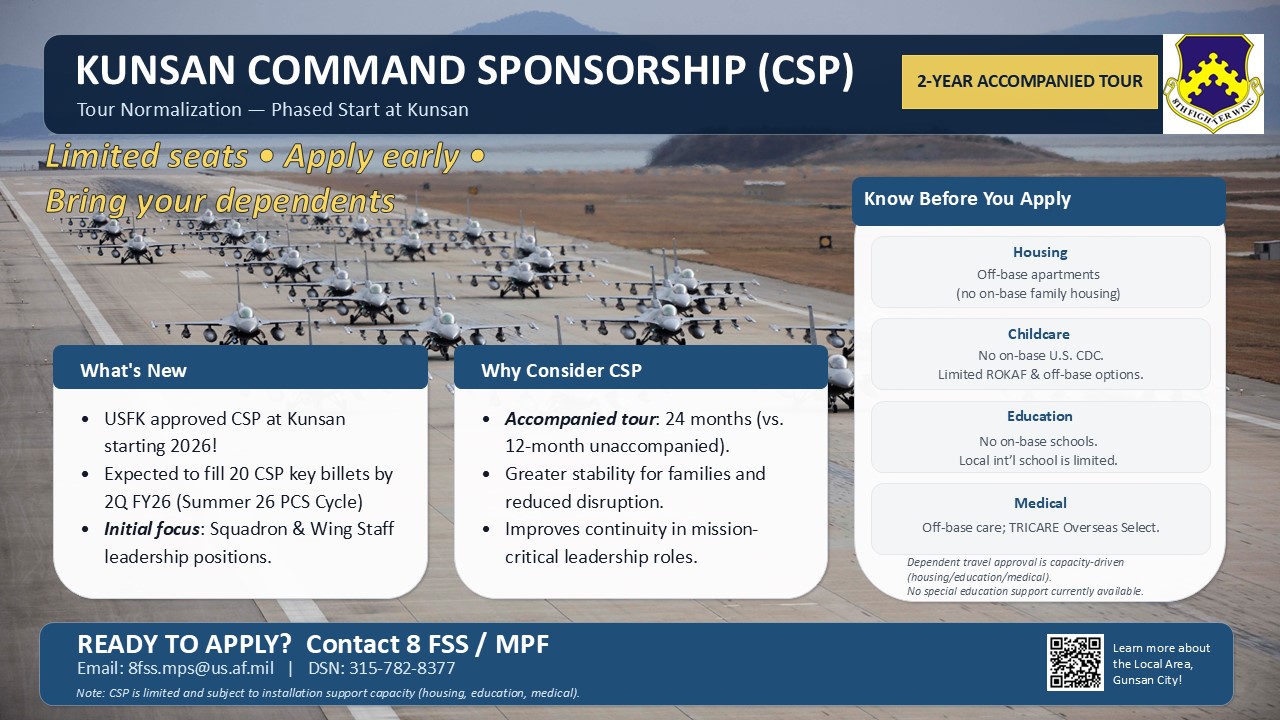
Kunsan Air Base is executing a phased, mission-prioritized shift toward Korea tour normalization by establishing an initial Command Sponsorship Program (CSP) capacity in FY26. This enables select, high-impact billets to bring dependents and extend assignment stability—directly supporting USFK’s “3-2-1” tour normalization objectives (stronger continuity, reduced turnover, improved readiness, and stronger family resilience).
How Kunsan Is Implementing Tour Normalization (Phased, Mission-Prioritized)
1) Start small, scale deliberately:
- CSP billets deliberately match & will change commensurate with dependent support capacity and mission requirements
2) Prioritize mission-critical leadership and continuity:
- The 8 FW/CC approved a Command Sponsored Prioritization List (CSPL) comprised of positions essential to mission execution and U.S. presence. These billets have fill-first priority.
- All members interested in command sponsorship must apply, regardless of CSPL priority. If approved, they will serve a 2-year accompanied Long Tour; if they do not apply for or are denied command sponsorship, they will serve a 1-year unaccompanied Short Tour.
- Note: This approach aligns with the broader USFK construct that allows tour length outcomes to be shaped by feasibility constraints and phased implementation.
3) Direct tie to readiness outcomes:
- 7 AF and 8 FW frame Kunsan’s CSP as improving operational effectiveness, mission continuity, and family resiliency, while advancing peninsula-wide tour normalization.
Installation Support Reality (What Kunsan Can Support Today)
Kunsan’s CSP is designed around base capacity, key constraints and mitigation factors:
Housing
- No on-base family housing; all dependent housing is off-base and on the economy (apartment-style). The 8 CES Housing Office provides support in finding available housing and coordinating with local realtors.
Childcare
- No U.S. Child Development Center
- ROKAF childcare is available first-come, first-served with capacity to support ~12–30 U.S. children (capacity-dependent). Off-base childcare options are on the economy and personally procured without base support/coordination.
Education
- No on-base schools.
- Off-base international school option supports up to ~40 children (capacity-dependent); boarding school options exist in major cities; standardized testing (SAT/ACT/PSAT) available via DoDEA sites at Osan AB/Camp Humphreys.
- No special education services currently available
Medical
- Dependents receive care off-base; limited local primary care specialties are identified (e.g., Family Medicine, Internal Medicine, Pediatrics).
- Dependents enroll in TRICARE Overseas Select; deductibles/copays apply for host-nation care.
Why This Matters to the Air Force (Operational Payoff)
This CSP implementation is a concrete, near-term mechanism to deliver the intended effects of tour normalization:
- Stabilizes key leadership and mission-critical billets by reducing turnover and training churn.
- Improves unit continuity and readiness through longer on-station expertise accumulation.
- Strengthens resiliency for members and families where support is feasible, while maintaining an exception pathway when it is not.